
Pressure Tested
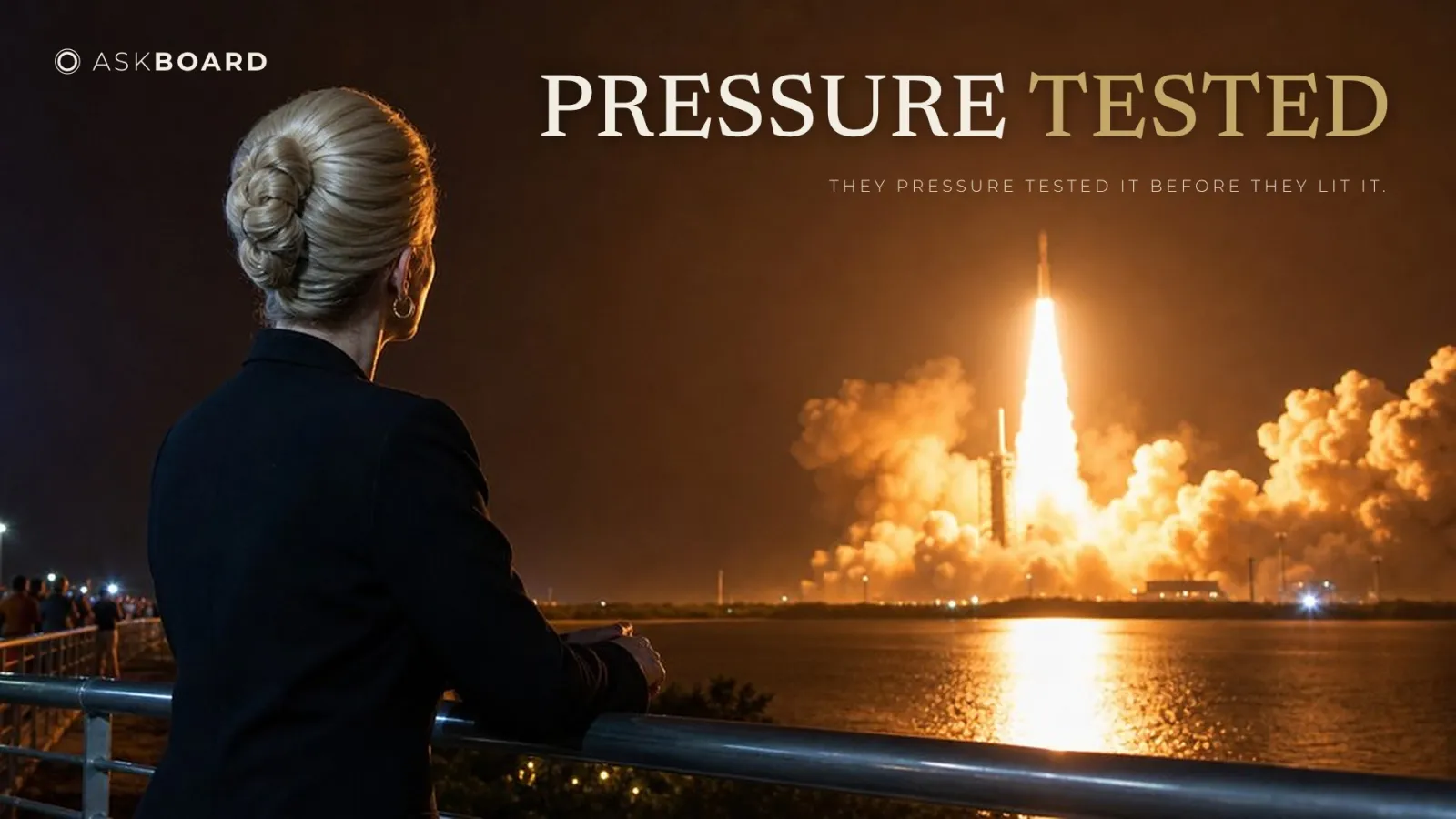
They pressure tested it before they lit it.
Every rocket you have ever watched leave the ground went through that sentence first. Not one engineer's opinion. Not the most confident person in the room. A process built to find the weak point before the weak point found the crew. The people who do this for a living are not pessimists. They are the only optimists who get to keep launching.
The same sentence is true of the bridge you drove across this morning, the surgery that went fine, the contract that held, the album that still sounds right ten years on. Behind each of them, somebody tested the thing before they committed to it. We take this so much for granted that we only notice its absence, usually in the news.
And then we open an AI, ask it the biggest question of the year, get one fluent paragraph, and act on it.
The one confident answer
I built AskBoard because one confident answer cost me a year.
The answer was well written. It was well reasoned on its face. It agreed with what I wanted to hear, which should have been the first warning, and it came back instantly, which was the second. I followed it. A year later I understood something I had known in every other part of my life and had forgotten the moment a machine spoke to me in complete sentences: a fluent answer can still be wrong, and a confident one can still be a guess.
What I had done was light the rocket on one opinion.
Here is the part that matters. The mistake was not that I used an AI. The models are extraordinary. The mistake was that I used one, alone, with nothing in the room that was built to disagree with it. A single model, asked a question, has every incentive to produce a complete, pleasing, finished-sounding answer. It has no incentive to say "the thing you are not asking about is the thing that will hurt you." Nothing in the room was paid to find the hole.
So I built the room.
What pressure testing is
Pressure testing is not "ask more AIs." If that were the idea, the product would be a dropdown.
It is a method, and the method has an order, and the order is the point.
First, the question goes to the Board: eight AI models, each from a different lab, one seat each. They answer blind. None of them sees what the others said. This matters more than anything that follows, because the moment one model sees another's answer it starts agreeing, and agreement is the one thing we are trying not to manufacture.
Second, the two seats that disagree most are put on stage and made to argue it out. Not the two best. The two furthest apart. Disagreement is the instrument. It is the only reliable way to find out where an answer is load-bearing and where it is decoration.
Third, the seats that watched report what they saw. Not a vote. A second look, from six angles, at what the argument exposed. A seat that changed its position says so, in its own words, and says what moved it.
Fourth, you get a turn. You know things about your situation that no model knows. The room is built so you can put them in while the argument is still live.
Then one answer survives. It comes with the reason it held, the next step, and the one thing to check before you act. Written down. Yours to keep.
That last item is the quiet heart of the whole thing. Every report names the single fact or test that would change the answer. Not a list of caveats. One thing. It is what a good engineer hands you when you ask "is this ready": the test that would prove it is not.
Why the number is not the point
People ask how many AIs are on the Board as if the number were the product. It is not. Fifty models that agree with each other are one model fifty times. Models trained on overlapping data inherit overlapping blind spots, and their agreement is often the same mistake in eight different voices. You could seat a hundred of them and learn nothing that one of them would not have told you.
What makes a pressure test work is the method. They answer without seeing each other. The room rewards the disagreement instead of smoothing it. The two furthest apart defend themselves out loud. A human gets a turn before the verdict. And the result is written, with its reason and its one open question, so it stays.
The ingredients are public. Every lab's model is available to anyone with a card. The recipe is the order, the blindness, the opposition, the human turn and the written record, and the recipe is ours.
There is one more thing the method does that the number never could. It makes being wrong visible. A single model that is wrong sounds exactly like a single model that is right. A room where seven seats hold and one refuses to move tells you where to look. The shape of the disagreement is information. We put it on the page.
Truth is what survives the argument
That line is on the front of askboard.ai because it is the belief underneath everything else.
It is how every field that cannot afford to be wrong already works. Science calls it peer review. Law calls it an adversarial system. Engineering calls it a test campaign. Aviation calls it a checklist read aloud by two people who are required to speak up if they see something. None of these professions assumes the first answer is right. They assume the first answer is the first answer, and they built a process to beat on it.
AskBoard is that process, for the questions that do not come with a profession attached. Should I take the offer. Is this plan ready. Is this chapter finished. Does this contract say what I think it says. Is this ad for real. Should we ship. The questions where there is no review board, so people default to the one confident voice in their pocket.
Now there is a board.
How it works, in practice
Bring the thing. A plan, a draft, a chapter, a photo of the offer, a contract, an idea in two sentences. The chair sharpens the question with you, because a vague question gets a vague argument. Then the Board argues it out. You can listen, or you can talk. When it closes, you keep what held: the answer, the reason, the next step and the one thing to check.
For everyday questions you do not need the Board. The everyday voice answers alone, every answer fact-checked by a second AI, with The Skeptic naming the one assumption that would change the answer. That is the daily AI. The Board is for when it matters.
And "when it matters" is a judgment you already know how to make. It is the moment you would call a friend who knows the field. The moment you would sleep on it. The moment you catch yourself hoping the answer is right instead of checking. Those are the questions to bring.
Why this, and why now
Everyone will have an AI. Most people already do. The question for the next ten years is whether you can tell which answers would survive contact with someone paid to find the hole. Answers themselves are free, fluent and instant.
We have never had a moment in human history where confident, well-written, wrong answers were this cheap. Every profession that handles real consequences built its defenses against exactly this over centuries. The rest of us got the fluent answer and no defense at all.
AskBoard is that defense: a room built to find the hole before you commit.
Great answers begin with great questions. Bring one. When it matters, ask the Board.