
The Answer That Survives
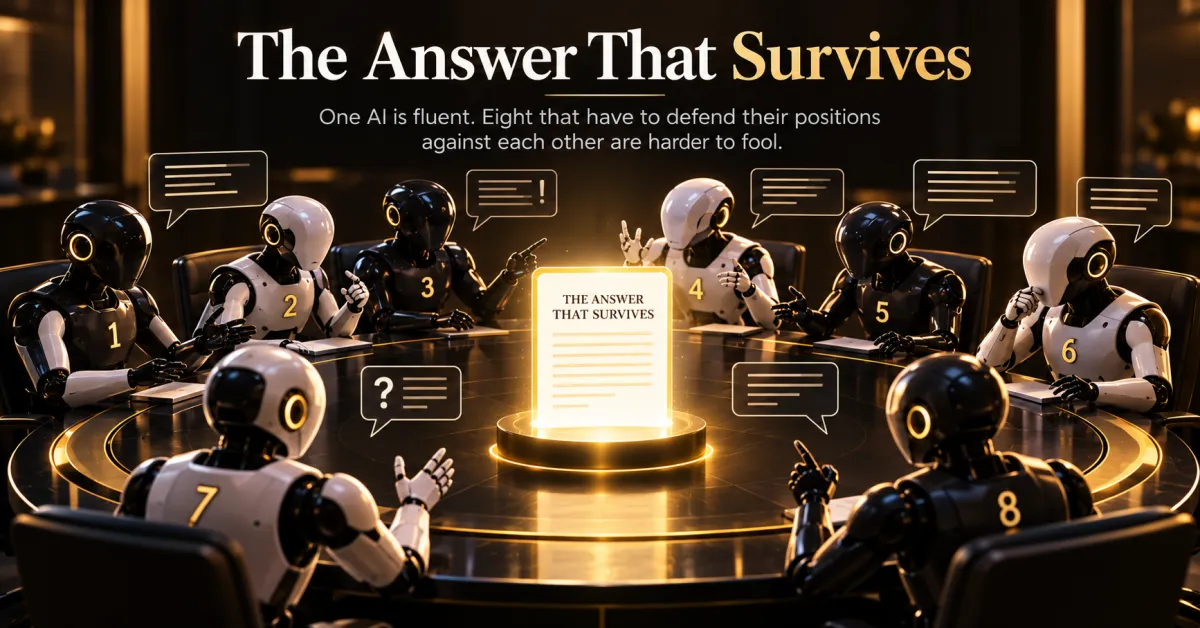
One model is fluent. A room of models that must defend their positions against each other is harder to fool.
AskBoard exists because of that difference. Everyday questions receive one answer from one voice, fact-checked by a second AI, and when one assumption would change the answer, The Skeptic names it. When the cost of being wrong is high, AskBoard brings in the Board: eight models from eight companies, one seat each. Grok, GPT, Claude, Gemini, Llama, Qwen, Mistral and DeepSeek answer blind. The two furthest apart argue it out. The others report what they saw. You get a turn. One answer survives, with the reason it held and the one thing to check before you act.
The product was built after a single model's confident, well-phrased recommendation consumed a year and real capital. The failure was ordinary. Models trained on overlapping data inherit overlapping blind spots. Agreement among similar systems is frequently correlated error wearing the appearance of confirmation. Placing the extremes in open conflict surfaces what a single voice smooths away.
What the public reports show
The public Full Board sample shows the mechanism in motion. The question was concrete: a job offer that pays 30 percent more requires leaving a team the candidate values and relocating. All eight models answered alone. GPT and DeepSeek were furthest apart and argued it out live, 36 turns with the chair in the room. Five seats aligned. Grok, Claude and Gemini held their positions and each stated what would move them. The answer: accept only if the role and the city remain desirable once the raise is reduced to its actual monthly figure after tax, rent, commuting and moving costs. Claude and Gemini pressed one more point, and both sides conceded it: staying does not keep the team the same, because teams change. The prescribed next step was narrow. Calculate that number, then spend one ordinary workday in the new city, a Tuesday, not a weekend.
A separate published session examined how to prevent a highly persuasive model from talking a user into a bad decision. The result was marked Split. GPT and Claude held their ground. The advice that held was structural rather than motivational: name, before the conversation begins, the single fact that decides the call and verify it only against a source you selected in advance; strip the model of any capacity to execute; and retain a human who knows your actual stakes as the final check on priorities. Each model was asked to propose a test that would prove its own safeguard had failed.
How to get the most from it
Every report closes with the same line: great answers begin with great questions. State the actual decision and the constraints already known: budget, timeline, non-negotiables, what has already been checked. Use a Full Board when you need to speak while the argument is still live. Keep everyday questions with the everyday answer. Bring in the Board when the cost of error is high. Execute the "do this week" item; it is the residual-risk hedge. For money above a threshold you set, for medical or legal questions, or for anything irreversible, pre-select the external sources that will serve as final judges. The models do not choose the referee. Retain the reports. They are yours.
A free account covers everyday questions. A Full Board is $30, or $20 on a plan. For people who use AskBoard every day, monthly plans begin at $17.95. Sample reports remain public at askboard.ai.
Why this is the layer that scales
Single models will continue to dominate low-stakes convenience. As systems become more agentic and more fluent, the dominant failure mode shifts from fabricated facts to accurate facts arranged in service of the wrong priority. The practical counter is not improved prompting inside one model. It is independent models built by different companies, forced argument at the extremes, independent fact-checking, and an explicit residual risk returned to the human.
Science, law and peer review already operate this way. AskBoard applies the same adversarial discipline to frontier models and packages it so a non-specialist can use it without constructing the workflow. The reports show models moving, models holding, weak points being named, and a person leaving with one recommendation and the precise step required to test it.
When the answer matters, one fluent voice is no longer the most reliable option available. The answer that survives the argument is.